
Read through on 19 October 2026
Dividing freight by weight, by item or evenly
Freight is charged on the whole parcel, so the group has to turn a single total into fair shares. Pick the rule before the quote arrives, and know where each rule goes wrong.
Splitting freight by weight, by item or evenly
International freight is charged on the parcel as a whole, so somebody has to turn one total into several shares. Three rules cover nearly every group: by weight, by item, and evenly. Each is simple arithmetic; the hard part is agreeing which one to use before the quote arrives, so nobody picks the rule that suits them after seeing the numbers.
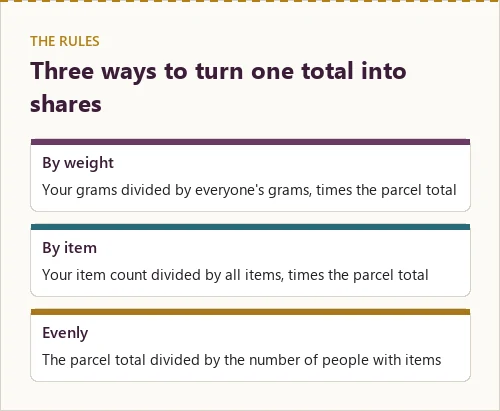
By weight, each person pays the parcel total multiplied by their grams and divided by everyone's grams. By item, the same calculation uses the number of items instead of grams. Evenly, the total is divided by the number of people who have something in the box.
The tally on the home page runs all three at once from your own figures. The sections below explain where the grams come from, when each rule misleads, and why the money always adds up to the cent.
Where the grams come from
A weight split is only as fair as the weights going into it. Seller listings often give no weight, or give a shipping weight rounded up for their own courier. The figure worth using is the one recorded when each item reaches the warehouse; agents of this kind usually show it on the order page. The archived CNFans pages did not describe their weighing, so check what the holder's account actually shows.
Packing and repacking can change the measured parcel weight: added protection increases it, while removal of original packaging may reduce it. Use the actual quoted charge and agree how shared packaging will be allocated. Item-weight proportions are an allocation rule, not a carrier calculation of chargeable weight.
Until real weights exist, leave the grams blank in the tally and use the item or even split as a provisional figure. Replace it with the weight split once the warehouse numbers are in.
Bulky, light items and parcels priced on size
Some shipping lines compare measured and dimensional weight using their own formula. Others have different charging rules. Do not infer which will apply from the product category; request the packed dimensions, charged weight and rule used for the actual quote.
When that happens, a pure weight split quietly undercharges whoever owns the bulky item. Their jacket weighs little, so their share is small, yet it is the reason the whole parcel costs more.
There are two common fixes. Switch to the item split for that parcel, or keep the weight split and agree that the bulky piece counts as heavier than its real weight. Settle the adjustment before the quote is known; an adjustment invented afterwards always looks like an ambush.
A sample parcel worked three ways
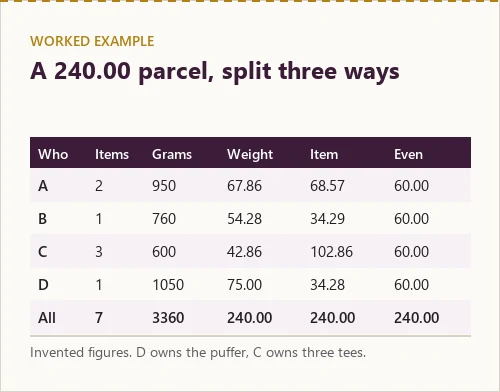
Take four friends and a parcel total of 240.00 (the figures are invented). A orders a hoodie and a cap, 950 g together. B orders jeans at 760 g. C orders three T-shirts, 600 g in all. D orders a puffer jacket at 1,050 g. That is seven items and 3,360 g.
By weight, D pays the most, 75.00, and C the least, 42.86. By item, C pays the most, 102.86, because three items count three times however light they are, while B and D pay about 34 each. Evenly, everybody pays 60.00. Same parcel, same total, and C's share ranges from 42.86 to 102.86 depending on the rule.
Notice D. Under the weight split D pays the most, which looks fair, but if the line priced this parcel on size because of the jacket, even 75.00 may be too little. That is the case the previous section describes. You can reproduce every number here in the tally.
Rounding to the cent without losing a cent
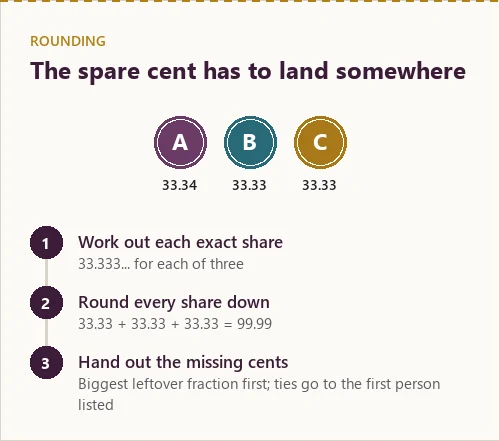
Divide 100.00 three ways and the exact answer is 33.333 recurring. Round everyone to 33.33 and the group is a cent short; round everyone up and somebody has overpaid. Small amounts, but in a group where money is already a sensitive subject, totals that do not add up cause more argument than they deserve.
The tally uses a largest-remainder rule. It rounds every share down to the cent, counts how many cents are missing, and hands them out one at a time to the shares that were closest to the next cent. When two shares are equally close, the person listed first gets the cent. The result always adds back to the total exactly.
If your group prefers another convention, such as the holder absorbing odd cents, that is fine; write it down. What matters is that the shares people pay add up to what the holder actually paid.
Costs that are not freight
Only the international freight, and anything chosen for the whole parcel, belongs in the split. Each item also carries its own costs: the price, and the seller's domestic shipping to the warehouse. Those stay with the owner. So does any extra service ordered for a single item, such as additional photos or special packing for something fragile.
One case catches groups out. When two friends order from the same seller and the seller charges a single shipping fee for the combined order, that fee belongs to the two of them, not to the whole group. Split it between those two, by item or evenly, and leave everyone else out of it.
Parcel-wide choices, such as a stronger box or any protection the holder adds for the whole shipment, are shared with the same rule as the freight. The archived CNFans help menu listed Packaging and Insurance and Compensation as topics but kept none of the detail, so check what is offered when the parcel is quoted.