
Read through on 19 October 2026
The friend whose name is on the parcel
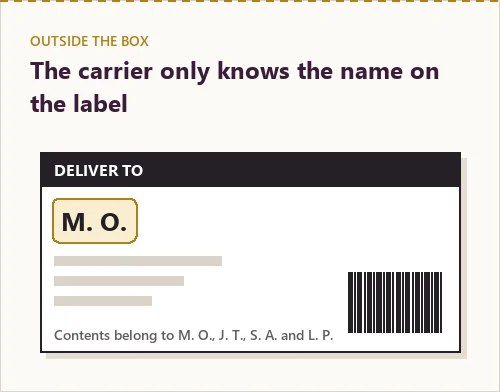
However many people paid, the box travels in one name. That person collects it, settles anything due before delivery, and answers questions about the contents.
Whose name goes on the label
A parcel goes to one person at one address, so a group order needs a receiver: the friend whose real name and home appear on the label. It has to be someone who lives there and can collect, because couriers and collection points may ask for identification that matches the name.
The archived CNFans help footer of 23 August 2026 listed a category called Receipt Information under Delivery. Its text was never captured, so this site cannot say what CNFans asked for at the address stage or how many addresses an account could hold. Check the address form yourself once the site is back.
Two habits help. Use the receiver's full name exactly as it appears on their documents, and never use the name of someone who has not agreed to receive the box. The person on the label is taking on more than a delivery, as the next section shows.
What customs pages say about the person receiving
Three official pages, read on 19 October 2026, describe the person at the receiving end in similar terms. U.S. Customs and Border Protection, on its Internet Purchases page (last modified 6 March 2024), says: “When you buy goods from foreign sources, you become the importer.” It adds that “The importer is ultimately responsible for paying any duty owed on an import” and that the agency “holds the importer - YOU - liable for the payment of duty not the seller.”
GOV.UK's guide Tax and customs for goods sent from abroad states that anything posted to you from another country “goes through customs to check it is not banned or restricted and you pay the right tax and ‘duty’ on it.” Its tax and duty section explains that Royal Mail, Parcelforce or the courier will contact you if anything is due, and send a bill.
For an EU destination, check the official import guidance and the receiving country’s customs information for the goods involved. VAT, customs duty, excise and carrier charges have different conditions. Agree who will receive and review any request, and retain the carrier’s actual assessment before dividing a cost. VAT page
A bill that arrives at a single door
When a charge is due before delivery, it is addressed to the receiver alone. GOV.UK says the carrier will “normally hold your parcel for about 3 weeks. If you have not paid the bill by then, your parcel will be returned to the sender.” Other countries have their own versions of that rule, and the logic is the same: the box waits for one person to pay.
In a group order this is where friendships get tested. The receiver may have to pay a bill for items that mostly belong to other people, and pay it quickly, before anyone has been asked for their part. If the receiver cannot or will not pay, everyone's items go back together.
So agree two things before the parcel leaves China: how any such bill is shared among you (the same rule as the freight is the simplest), and how many days everyone has to repay the receiver once the bill is known. This site does not estimate what any bill will be; it only helps you decide who pays which part of it.
Picking the receiver
The receiver and the account holder can be the same person, and often are, but they do not have to be. The holder needs to be organised online; the receiver needs to be reliably at home, or close to a collection point, during the weeks the parcel might arrive.
Money matters too. A receiver who would struggle to pay an unexpected bill should not carry that risk for everyone. Some groups ask the receiver to hold a small float collected in advance; others accept that the receiver pays first and set a short repayment window. Either works if it is agreed in writing.
Finally, the receiver should know exactly what is in the box. Ask the holder to send the full item list, with owners, before the parcel is submitted. Nobody should accept a parcel in their own name without knowing what it holds.
What the receiver has not signed up for
Being the receiver means accepting the box and dealing with whoever contacts you about it. It does not mean paying for anyone else's items, carrying anyone else's losses, or running a free postal service for the group. Those are separate questions, and they should be answered separately.
Write down what each owner keeps responsibility for: their own item price, their freight share, their part of any bill and the cost of getting their share from the receiver to themselves. Then write down what is shared, usually only losses discovered when the box is opened, and only if the group has agreed to share them.
A receiver who has been taken for granted once rarely volunteers again. Making their limits explicit is what keeps the arrangement repeatable.
Questions from the carrier or customs
Occasionally a carrier or a customs office asks the receiver for more information about a parcel: what is inside, what it cost, or proof of purchase. The receiver is the person who must answer, and the answer has to be accurate. CBP's page for online buyers is blunt about who carries the consequences when it is not: the importer.
This is why the holder's record matters to the receiver. With the order list, the amounts paid and the receipts to hand, the receiver can answer truthfully without guessing about items that belong to someone else.
Chip-In does not give guidance on customs forms, on what to write in them, or on how any charge is calculated. Follow the instructions from the carrier or the customs office itself, and use their official pages linked above.