
Read through on 19 October 2026
Clearing the money before the box leaves China
Money moves at three moments in a group order. Settle each one before the next begins, agree whose exchange rate counts, and keep a balance everyone can read.
Settling up ahead of dispatch
Money in a group order moves at three moments. Before ordering, each person pays for their own items and their sellers' shipping. Before the parcel is submitted, each person pays their freight share. After delivery, if the receiver had to pay a bill to get the box released, everyone pays their part of that.
The rule that prevents most trouble is simple: settle each stage before the next one starts. Nobody's items are ordered until they are paid for, and the parcel is not submitted until every freight share is in. That way the holder never ends up lending money, and nobody's lateness traps everyone else.
The rest of this page covers the details that make settling awkward: currency, a balance everyone can read, late payers, and closing the books after delivery.
Item money first, freight money second
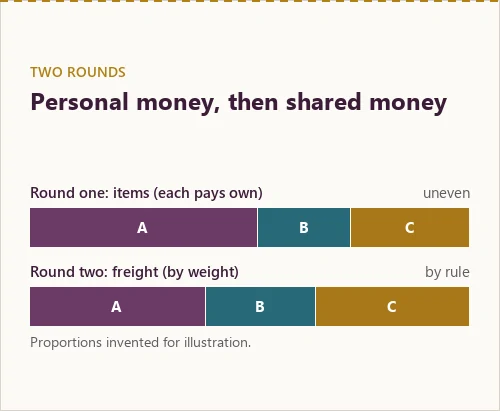
Agents of this kind usually charge in two steps: the goods first, when they are bought, and international freight later, once the items are packed and the parcel can be quoted. For a group, that means two separate rounds of collecting, with different rules.
The first round is personal. Each friend pays exactly what their own items cost, plus their sellers' domestic shipping. Nothing is shared except, occasionally, a single seller's shipping fee between two friends who bought from the same shop.
The second round is shared. The freight total is divided by whichever method the group chose, using the tally or the worked example on the freight page. Keep the two rounds apart in the record, so it is always clear which money paid for what.
Exchange rates and card charges
Unless everyone lives in the same country and banks in the same currency, a group order involves conversion. The holder tops up the wallet with a card, and the card issuer converts at its own exchange rate, sometimes adding a fee. The friends then repay the holder in their own currency, through whatever transfer method they use, which may carry its own fee.
These differences are small per person and add up across a group. The cleanest convention is to use the amount that actually left the holder's account, as shown on their card statement, and to split any card fee in the same way as the money it was charged on.
Agree also who absorbs transfer fees between friends. Usually it is the sender, so the holder receives the full amount owed. Whatever you choose, write it down before the first payment.
A running balance everyone can read
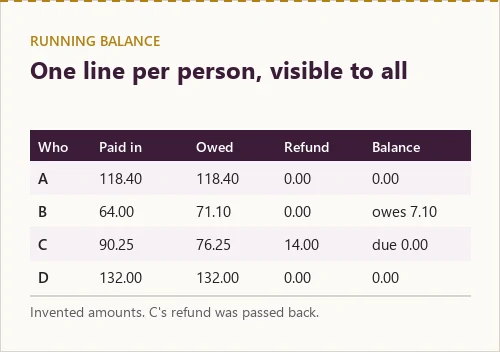
Alongside the event record the holder keeps, maintain a running balance per person: what they have paid in, what they owe so far, any refunds due to them, and the difference. Update it whenever money moves, and pin it where the whole group can see it.
A visible balance turns awkward conversations into simple ones. Nobody has to ask the holder what they owe; the number is there. Nobody has to wonder whether a refund was passed on; the line shows it.
Aim to bring every balance to zero before the parcel is submitted, apart from anything that cannot be known until delivery. Then close it again after delivery, once any bill has been shared and every share has been handed over.
Late payers and a parcel that waits
Warehouses do not keep items forever without charge. Agents usually allow a free storage period and charge after it; the archived CNFans pages listed Storage as a help topic but did not keep its terms, so this site cannot say how long that period was. Either way, a parcel waiting for one late payer is costing time for everyone.
Set a freight deadline and decide in advance what happens when it passes. The fairest common answer is that the parcel goes without the late payer's items, which wait for a later parcel at that person's cost. It sounds strict, but it means nobody's order is held hostage by somebody else's week.
Removing items changes the freight quote, so rerun the shares on the new figure. The person whose items stayed behind owes nothing for this parcel's freight.
Closing the balance once the box arrives
After delivery a few amounts are still open. Any bill the receiver paid to release the parcel is shared out by the rule agreed before dispatch, and repaid within the agreed number of days. Second postage and packing materials are repaid to the receiver. Any late refunds or claim outcomes are passed on.
When every balance reaches zero, ask each person to confirm it in the group chat. It feels formal, but it is the moment that ends the arrangement cleanly, and it makes the next group order easier to start.
Archive the record and the balance together. If the same friends order again, begin with fresh ones rather than carrying credit or debt forward; old balances are where long memories start.