
Read through on 19 October 2026
From the receiver's door to each friend
Delivery puts every share in one hallway. Open the box with evidence, sort it against the list, and get each share to its owner without the receiver paying for the privilege.
Getting each share from the receiver to its owner
Once the parcel is delivered, the receiver is holding everybody's things. The final job of the group order is to get each share out of that hallway and into its owner's hands, quickly and without arguments about what was in the box.
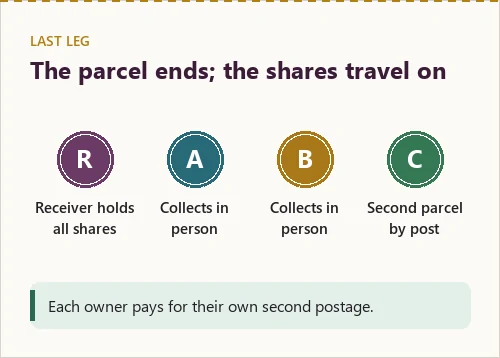
Friends who live nearby collect in person. Friends further away need a second, domestic parcel, which costs money and introduces one more chance of loss. Both routes go better when the box was opened carefully and each share was checked and labelled before anything left the receiver's home.
This page goes through the handover in the order it usually happens: opening, sorting, posting on, collecting, and the share nobody comes to fetch.
Opening the box on camera
Ask the receiver to film the unboxing, starting with the sealed parcel and its label in view, in one take without cuts. Each item comes out and is shown to the camera before it is put on its owner's pile. Anything damaged, missing or unexpected gets a pause and a close look.
The video does two jobs. It is the best evidence the account holder will have if a claim is needed, and it protects the receiver from any suggestion that something went missing in their hands. A friend who can watch their item come out of the box has no reason to wonder.
Share the file with the whole group on the day it is made, and keep it until every share has been accepted by its owner.
Sorting shares by initials
With the box open, the receiver sorts everything against the item list the holder shared before dispatch. Each share goes into its own bag marked with its owner's initials, the same initials used in the tally. Anything on the list but not in the box is written down there and then.
A quick photo of each bag, sent to its owner, closes the loop. The owner can confirm it looks right, or spot a mix-up between two similar items before they travel to different cities.
Sorting is also the moment to check that nothing in the box is unaccounted for. Every item should belong to someone on the list. If one does not, tell the holder at once rather than guessing whose it is.
Second postage inside the country
Friends who cannot collect need their share posted on. The owner pays for that second parcel, at the price the receiver actually paid, and the two of them choose the service together. A tracked service costs a little more and saves a lot of uncertainty.
Agree in advance who carries the risk on this leg. The usual answer is the owner, because they chose not to collect, but some groups prefer to share it. Either way, the receiver's job is to pack the share sensibly and post it within the time agreed, not to insure it out of their own pocket.
Put the tracking number in the group record. If the owner pays the receiver back for postage and packing materials, record that too, so the tally closes cleanly.
Collecting in person
For friends nearby, collecting is the cheapest route, but it works best with a window rather than an open invitation. The receiver names a few evenings or a weekend; everyone books a slot. Otherwise the shares sit in the receiver's home for weeks, and the receiver becomes an unpaid storeroom.
When the owner collects, they check their bag against the photo already sent and say so. That small step means a problem found three days later at home is clearly a new question, not a dispute about what was handed over.
Meeting somewhere else, such as a café or a station, is fine too, as long as the receiver is not left carrying four bags across town for free.
If the receiver shares a home, agree where the bags wait until they are collected, so nobody outside the group moves or opens them by mistake.
When a share is never collected
Occasionally a friend loses interest once the excitement is over and their share just sits there. The receiver should not have to store it indefinitely, and should not have to decide alone what to do with it.
Agree a fallback when you agree everything else: after the collection window, a first reminder; after a second reminder with a final date, the share is posted on at the owner's cost, or handled however the group chose. Writing it down beforehand means the receiver is following a rule, not taking a liberty.
This is rare among close friends, which is one more reason group orders work best inside a small circle where everyone already knows how the others behave.