
Read through on 19 October 2026
Several of the same item in a single box
Friends often want the same thing. Here is what official customs pages say about lookalike items in one parcel, in their own words, and nothing that tries to get round them.
Several identical items packed together
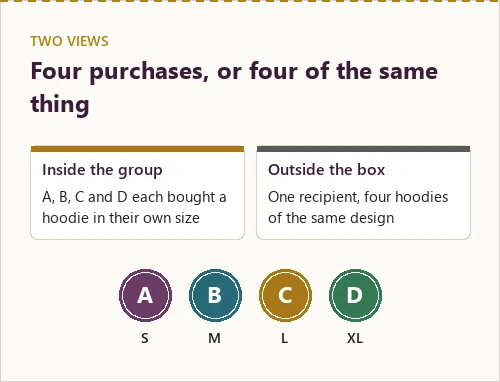
Friends tend to like the same things, which is often why they order together in the first place. Four of you fall for the same hoodie, and four of them go into the box in four sizes. Inside the group, nothing could be more ordinary: four people, four purchases, each paid for separately.
From the outside, the picture is different. The parcel is addressed to one person, and inside it are several copies of the same garment. Nobody looking at the label knows about the group chat, the separate payments or the four sizes. They see one recipient and a handful of identical items.
This page sets out what official customs guidance says about that situation, in the agencies' own words, and then explains why this site goes no further than quoting it.
What CBP says about personal use
The clearest official statement we found is on the U.S. Customs and Border Protection page Internet Purchases, read on 19 October 2026. Under the heading on personal and commercial use, it explains that many import regulations apply only to goods brought in for business purposes, and then adds a note: “U.S. Customs and Border Protection is authorized to make judgment calls about what qualifies as personal use. Several suits that are identical or a number of very similar handbags will have a hard time passing the credibility test as items for personal use.”
The same page says that “Goods imported for commercial purposes must comply with a variety of special requirements, such as marking of country of origin,” and that an invoice should accompany commercial shipments. In other words, how a parcel is read changes which rules apply to it, and the reading is the agency's to make, not the buyer's.
The page gives no number of items at which personal use ends, and neither does this site.
The UK and EU pages, read for the same question
The GOV.UK guide Tax and customs for goods sent from abroad does not discuss quantities or personal use in its overview. What it does say, to whoever receives the parcel, is that goods sent from abroad go through customs, that the parcel or courier company will tell you if anything is due, and that “Your goods may be seized if you do not follow the rules. You may also be fined or prosecuted.”
For an EU destination, review the current official import and VAT information for the particular goods and receiving country. Different charges have different conditions; a group order does not make every possible charge automatically applicable or exempt. Confirm the carrier’s requested documents and charges before agreeing on a group budget. VAT page
None of the three pages mentions friends ordering together. They speak to the person receiving the goods. For a group order, that is the receiver, which is why the receiver should know what is in the box and agree to receive it.
How a group basket looks from the outside
A group parcel will often look different from a solo one: more items, more variety, sometimes several of the same thing, all addressed to one person. That is simply what pooling looks like. The group cannot decide how an official will read it, and should not try to.
What the group can control is honesty and readiness. The receiver should see the complete list of items and owners before the parcel is submitted. The holder should keep receipts and order records where the receiver can reach them. And the receiver should have agreed, knowingly, to receive this particular box.
If a carrier or customs office asks questions, the receiver answers accurately from those records, as the receiver page describes. That is the whole of what this site recommends.
What this page will not tell you
Some readers arrive here hoping for a number: how many of the same item is safe, or how to arrange a parcel so it attracts less attention. This site does not give that kind of advice, in any form.
It does not suggest limits on identical items, ways of packing or describing a parcel, or whether splitting goods across parcels or combining them changes what anyone pays. It does not quote charge thresholds or explain how to use them. Those questions belong to customs authorities, and advice that tries to work around them puts the receiver, a friend, at risk.
What remains is narrower and more useful for a group: knowing that the receiver answers for the whole box, and organising the order so the receiver can do that with a clear conscience.
Talking it through before anyone orders the same thing
When several friends want the same item, raise it with the receiver before anyone orders. Say what is planned, how many, and for whom, and ask plainly whether they are comfortable receiving that box. A receiver who hesitates is giving the group useful information.
If anyone is unsure how a parcel will be treated, the official advice is to ask the authority itself. CBP's page puts it directly: “If you have any question at all about your purchase, you should contact your closest CBP port and get an opinion before you complete the transaction.” In the UK, GOV.UK points people to their parcel or courier company for questions about their goods.
And if the receiver is not comfortable, the answer is to change the plan so that nobody answers for items they did not agree to, for instance by the friends who want them ordering in their own name, not to change how the box is described. The aim is a receiver who knows exactly what they are accepting.